01463 223243

 Find
 Book


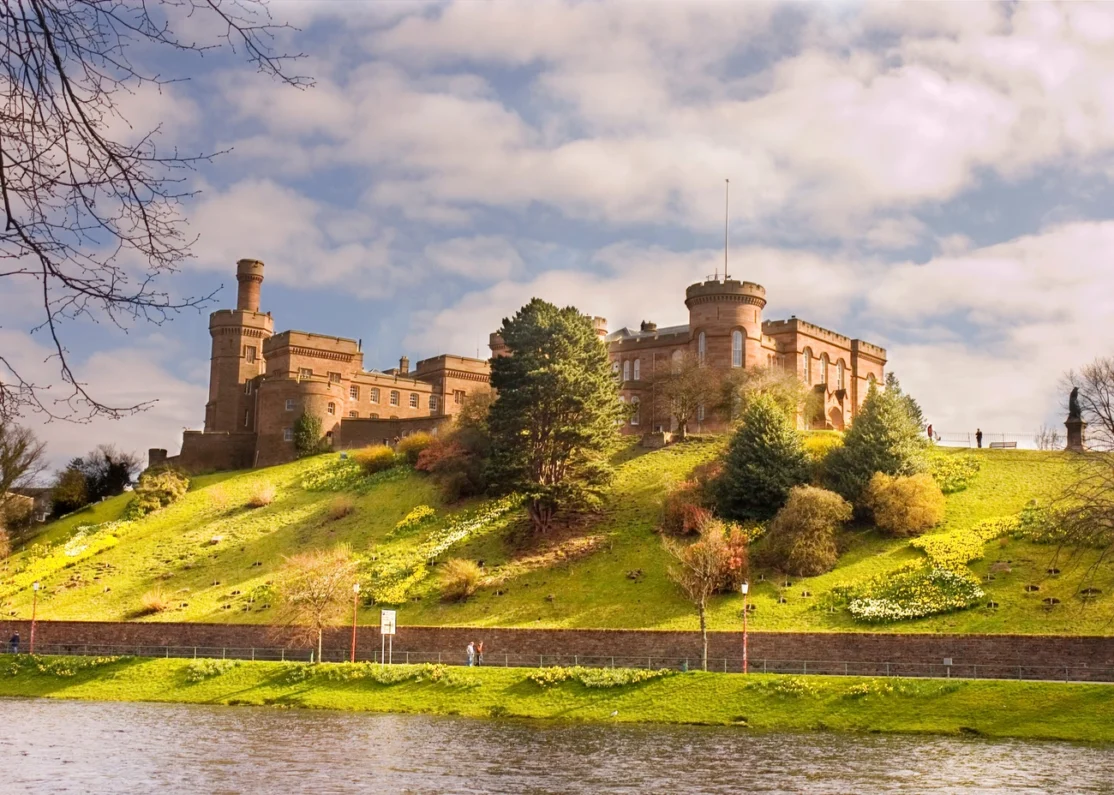
Inverness castle stands as a testament to Scottish history for almost a millennium. The first fortress appeared on its site in 1057 . This iconic landmark sits majestically on the River Ness banks. It survived royal sieges and violent attacks until Bonnie Prince Charlie’s forces blew it up in 1746 .
The castle we see today dates back to 1836 , though its foundations tell an older tale. The building served various purposes through its rich history. A Category A listed building , it now stands at the centre of a £39m project to create an amazing tourist destination . The transformation received £34.5m in funding, with £30m coming from the Inverness and Highland City Region Deal . The project faced some setbacks, and visitors will need to wait until late summer or early autumn 2025 . Plans for renovation are extensive. The historic Rose Window will return to its former glory, and new green spaces will emerge on the esplanade . The building served as a courthouse until 2020, when the Scottish Courts and Tribunal Service moved out . The castle’s walls hold fascinating stories and secrets that await visitors.
The early days of Inverness Castle
Inverness Castle’s strategic importance dates back many centuries before the structure we see today. The earliest known settlement emerged in the 6th century AD. The Picts built their stronghold overlooking the River Ness [1]. The original fortress stood across the river at Craig Phadraig, where Pictish King Brude welcomed St Columba [2].
The first wooden fort and its strategic location
King David I, son of Malcolm III, built the first fortification at the present castle site [2]. This early fortress featured earth and timber construction with protective ditches and earthen ramparts [2]. The castle’s location at the River Ness mouth proved perfect to control river traffic and land routes. This strategic position helped Inverness grow into a prominent Highland cultural and trading hub [3].
Malcolm III and the destruction of Macbeth’s stronghold
Malcolm III shaped local history in 1057 when he destroyed his rival Macbeth’s fortress at nearby Crown Hill [2]. This victory led to a series of castles that would stand at the current site from 1057 onwards [4]. William Shakespeare’s famous portrayal of Duncan’s murder by Macbeth at Inverness Castle in 1040 differs from historical fact – Duncan fell in battle near Elgin [5].
The castle’s role in the Wars of Independence
The castle’s strategic value made it a prime military target during mediaeval times. English troops under Edward I seized the fortress in 1303 during their Scottish conquest campaigns [5]. This occupation happened just two years before William Wallace met his end [2]. Robert the Bruce reclaimed the castle in 1308 [4]. Bruce then razed the castle to stop English forces from using it [2]. This destruction aligned with his “scorched earth” strategy that denied resources to invaders [2].
The castle’s early history mirrors Scotland’s journey – a cycle of construction, capture, and destruction as different powers fought to control this crucial Highland gateway.
Secrets from the mediaeval and royal era
Royal plots and dramatic confrontations that shaped Scotland’s history took place behind the mediaeval walls of Inverness Castle. This fortress became the stage for some of Scottish history’s most decisive moments as power struggles erupted throughout the Highlands.
James I’s ambush of Highland clan chiefs
King James I made a calculated move in July 1428. He summoned fifty clan chiefs to Inverness Castle under the guise of a parliamentary meeting [6]. His real plan became obvious when he ordered his men to “arrest, iron, and imprison each chief in different apartments and debar them from having any communications with each other or with their followers” [4]. The king’s men executed several chiefs right away [4]. Alexander, Lord of the Isles, and his mother, Mariota, Countess of Ross ended up among the prisoners [4].
Alexander spent twelve months in captivity. He came back to Inverness with 10,000 men and burned the town to get revenge. The castle itself remained out of his reach [4]. This whole ordeal led to Highland rebellions that lasted throughout the 15th century [2].
Mary, Queen of Scots and the 1562 siege
The castle witnessed its most famous royal drama in September 1562. Mary, Queen of Scots arrived at Inverness Castle on September 9th only to find the gates locked against her. Alexander Gordon had sealed them shut on orders from George Gordon, Earl of Huntly [7].
The young 20-year-old queen refused to back down from this insult. She called her loyal supporters to arms. Contemporary accounts tell us that “as soon as they heard of their sovereign’s danger, a great number of the most eminent Scots poured in around her, especially the Frasers and Munros, who were esteemed the most valiant of the clans” [4]. The castle’s defenders gave up after a three-day siege [7]. Mary showed her authority swiftly – Alexander Gordon faced the hangman’s noose for treason, and his head was displayed on the castle walls [7].
The hidden chapel built by the Earl of Huntly
George Gordon, Earl of Huntly’s relationship with the crown remained rocky after these events. He controlled the entire north with Argyll’s help when Mary escaped to England in 1568 [8]. The earl left his mark on Inverness Castle during this religiously volatile period. He built a hidden chapel inside the castle that served as a safe haven for Catholic worship as Protestant influence grew.
The earl made peace with Regent Moray at St Andrews on May 14, 1569 [8]. He agreed to give up the royal cannon stored at Huntly Castle, which weakened his military power in the north.
The Jacobite connection and explosive events
Inverness Castle’s stone walls tell stories of the tumultuous Jacobite period. The fortress changed hands many times as Britain struggled with political and religious conflicts.
The 1715 Jacobite occupation
Jacobite forces briefly took control of the castle in 1715 [9]. Their stay didn’t last long when Hanoverian supporters threatened to destroy it [10]. Simon Fraser, Lord Lovat, led the siege with help from Clan Rose and Clan Forbes [9]. The Hanoverians successfully reclaimed the fortress on 12 November 1715 [9]. The victors renamed it Fort George to honour King George I and strengthened its defences [2].
Why Bonnie Prince Charlie ordered its destruction
Prince Charles Edward Stuart seized the castle on 21 February 1746 after his troops’ mining operations forced government soldiers to give up [2]. The Prince knew he couldn’t hold the castle forever and made a bold choice. He decided to blow up the entire structure with explosives to stop it from becoming a government stronghold again [5].
The tale of the French sergeant and his dog
The castle’s final moments created one of Inverness’s most remarkable stories. A French sergeant checked a delayed explosive charge while setting up the demolition [5]. The blast threw his body across the River Ness [11]. His loyal poodle, who never left his side, survived the explosion [11]. Some stories say the dog lost just the tip of its tail and became the Jacobites’ lucky charm afterward [12].
Modern transformations and overlooked details
The ruins of Inverness Castle found new life through a complete reimagining during the 19th century. These changes left behind the sort of thing I love – fascinating details that most visitors miss today.
When was Inverness Castle built in its current form?
The red sandstone structure we see today emerged in two distinct phases after the Jacobite destruction left it in ruins. Architect William Burn designed the courthouse that was completed in 1836 [4]. Thomas Brown II added the north block in 1848 [4], which served as a prison. Joseph Mitchell [4] designed the castle’s distinctive perimeter walls in 1839 [2], though visitors often walk past them without a second glance.
The story behind the Rose Window
The historic Rose Window stands as maybe even the most remarkable hidden treasure. Craftsmen originally created it in 1867 for a Methodist Church in Inverness [13]. James Keith, a Dingwall bookseller, gifted this exquisite feature that cost £1200 [14]. The castle’s transformation project now includes careful restoration of this window. Local stonemasons clean each stone fragment with precision, while Iona Art Glass specialists restore the stained glass panels [13].
The £50 note and its castle illustration
The castle’s influence reaches beyond its physical presence. The Royal Bank of Scotland chose to feature Inverness Castle’s illustration on their £50 note’s reverse side in 2005 [4].
Flora MacDonald‘s statue and its symbolism
The bronze statue of Flora MacDonald has stood proudly before the castle since 1896 [2]. She gazes westward, eternally awaiting Bonnie Prince Charlie’s return [15]. This 129-year-old monument now undergoes careful restoration [16]. The work removes green discoloration and brings back its original bronze finish.
Conclusion
Inverness Castle has stood majestically over the River Ness for almost a thousand years. This Highland sentinel holds nowhere near all its secrets that visitors find. The castle’s transformation from wooden fort to sandstone landmark tells a story of royal ambushes, dramatic sieges, and calculated destruction. Today’s castle looks completely different from its mediaeval versions but still carries Scotland’s turbulent history.
Malcolm III’s tales, James I’s treacherous clan chief trap, and Mary Queen of Scots’ defiant three-day siege explain why everyone wanted this fortress. Bonnie Prince Charlie showed its strategic value during the Jacobite risings when he destroyed it rather than surrender.
The castle lay in ruins until the 19th century. A striking red sandstone structure rose from the ashes to define Inverness’s skyline. Most visitors miss interesting details like the Rose Window’s story or the meaning behind Flora MacDonald’s statue’s westward gaze.
A new chapter unfolds at the castle. A £39 million project will revolutionise how visitors experience this historic landmark. Careful restoration work and new public spaces will breathe fresh life into this ancient site.
The castle looks different now from when Highland chiefs met their fate or when Mary Queen of Scots showed her royal power. It keeps evolving while honouring its remarkable past. Without doubt, Inverness Castle remains true to its essence – a witness to history and the Highland capital’s enduring symbol in Scotland’s story.
Key Takeaways
Discover the fascinating hidden stories behind Inverness Castle that reveal nearly a millennium of dramatic Scottish history, from royal betrayals to explosive destruction and remarkable resurrection.
• The current red sandstone castle dates from 1836-1848, built on a site that has hosted fortresses since 1057, including Macbeth’s destroyed stronghold.
• King James I orchestrated a notorious 1428 ambush, imprisoning 50 Highland clan chiefs under false pretences of a parliamentary meeting.
• Mary, Queen of Scots laid siege to her own castle for three days in 1562 when locked out, ultimately hanging the defiant gatekeeper for treason.
• Bonnie Prince Charlie deliberately destroyed the mediaeval castle with explosives in 1746 to prevent government forces from reclaiming this strategic Highland gateway.
• The castle’s £39 million transformation includes restoring the historic Rose Window from 1867 and will reopen as a major tourist attraction in 2025.
• Flora MacDonald’s bronze statue gazes westward towards Skye, symbolically awaiting Bonnie Prince Charlie’s return, whilst the castle features on Scotland’s £50 note.
These hidden secrets transform a simple castle visit into a journey through Scotland’s most turbulent chapters, revealing why this Highland fortress remained so strategically vital throughout centuries of conflict and change.
FAQs
Q1. What is the current status of Inverness Castle? Inverness Castle is undergoing a £39 million transformation project to become a major tourist attraction. The renovation includes restoring the historic Rose Window and creating new public spaces. The castle is expected to reopen in late summer or early autumn 2025.
Q2. What significant historical events occurred at Inverness Castle? Several notable events took place at Inverness Castle, including King James I’s ambush of 50 Highland clan chiefs in 1428, Mary Queen of Scots’ three-day siege in 1562, and Bonnie Prince Charlie’s capture and subsequent destruction of the castle in 1746 during the Jacobite Rising.
Q3. How old is the current Inverness Castle building? The red sandstone structure visible today was built in two phases during the 19th century. The courthouse was completed in 1836, followed by the north block (originally used as a prison) in 1848. However, the site has hosted fortifications since 1057.
Q4. Are there any hidden features in Inverness Castle? Yes, the castle has several overlooked details. These include the historic Rose Window from 1867, which is currently being restored, and the bronze statue of Flora MacDonald installed in 1896, which stands before the castle gazing westward.
Q5. How can visitors experience Inverness Castle’s history? While the castle is currently closed for renovations, visitors can still admire its exterior and learn about its rich history. The surrounding area offers views of the castle and River Ness. Once reopened, the castle will provide a new immersive experience showcasing its centuries of dramatic Scottish history.